121℃ Glass Grains Hydrolytic Resistance Testing
I. Aligning with International Standards: The Rigorous Requirements of 121℃ Pressure Testing and Precise Particle Size Control
In the USP <660> Containers – Glass, Ph. Eur. 3.2.1 Glass Containers for Pharmaceutical Use, and international standards ISO 720 / ISO 719, the 121℃ high‑temperature, high‑pressure moist heat sterilization condition (121℃, 15 psi / 0.1 MPa, saturated steam) has long been the standard method for determining the hydrolytic resistance of pharmaceutical glass grains (Glass Grains Test). This test is designed to accurately simulate the chemical resistance performance of pharmaceutical glass containers under high‑temperature sterilization and long‑term storage, effectively providing early warning of the risk of alkaline substances and glass leachates.
Sample Preparation Challenges Under International Standards: According to USP <660> and Ph. Eur. 3.2.1 specifications, glass grains used for testing must be strictly screened and confined to a specified particle size range (e.g., 250–425 μm / 300–425 μm). Traditional manual crushing and hand sieving often lead to over‑crushing, excessive generation of fine dust, and surface deformation, resulting in significant deviations in titration or extraction data, which directly impact the international registration and export compliance of pharmaceutical packaging materials.
II. Automated Compliance Solution: Core Advantages of the Sumspring PSD-50S Automatic Glass Crushing Machine
Sumspring has developed the PSD-50S Automatic Glass Crushing Machine to address the sample preparation challenges faced by multinational pharmaceutical companies, export‑oriented glass manufacturers, and third‑party testing laboratories when performing USP <660> / Ph. Eur. 3.2.1 / ISO 720 testing:
One‑Button Standardized Automatic Crushing: Built‑in precision hammering and automatic feeding program; the instrument automatically determines the test endpoint with no manual intervention required. It effectively controls crushing impact force and eliminates over‑crushing caused by manual hammering.
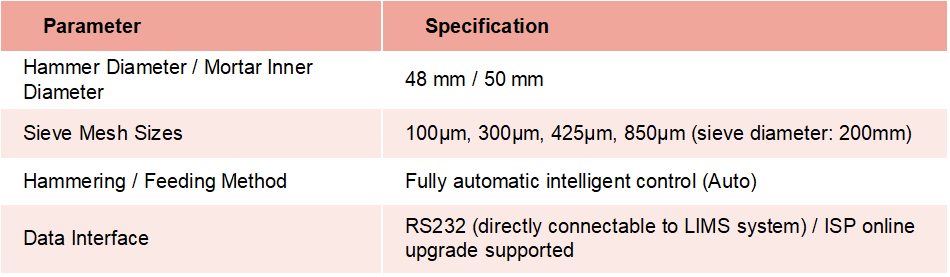
Multi‑Level Sieves Compliant with International Standards: Equipped with standard sieves of various mesh sizes including 100μm, 300μm, 425μm, and 850μm (diameter 200mm), perfectly matching the sieve size requirements specified in USP <660> and ISO 720 to ensure extremely low coefficient of variation (CV) in sample preparation.
Data Integrity and 4‑Level Permission Management (21 CFR Part 11 Compliant): Features 4‑level independent user hierarchical permission management and customized authorization functions, with password protection and encrypted log recording to easily meet FDA / EMA audit requirements.
Seamless LIMS System Integration: Equipped with an RS232 communication interface, easily connectable to laboratory LIMS electronic information systems for automatic test data transmission and compliant traceability.
Laboratory EHS Protection: Fully enclosed crushing chamber with noise reduction design, power‑off memory, and overload protection, completely eliminating glass splashing and dust inhalation risks, meeting international laboratory EHS safety standards.
III. PSD-50S Key Technical Specifications (Aligned with ISO / USP / Ph. Eur. Standards)
Applicable International Standards:
- USP <660> Containers – Glass (Glass Grains Test)
- Ph. Eur. 3.2.1 Glass Containers for Pharmaceutical Use
- ISO 720 / ISO 719 Glass — Hydrolytic resistance of glass grains
IV. Conclusion
By utilizing the automated sample preparation solution of the Sumspring PSD-50S Automatic Glass Crushing Machine, enterprises can eliminate manual sample preparation deviations, ensure high reproducibility and authority of test data, seamlessly meet the 121℃ glass grains hydrolytic resistance testing requirements of USP <660>, Ph. Eur. 3.2.1, and ISO 720, and facilitate smooth passage of international registration and certification.