Data Integrity in Pharmaceutical Packaging Testing: How Sumspring Ensures GMP & 21 CFR Part 11 Compliance
Data integrity is the foundation of quality control and regulatory compliance in pharmaceutical and biotech manufacturing. Every piece of data – from batch records to test results – must be traceable, legible, contemporaneous, original, accurate, complete, consistent, enduring, and available (the ALCOA+ principles). Maintaining these attributes is essential for ensuring product quality, patient safety, and regulatory trust.
This article explores how Sumspring instruments are engineered to meet these stringent data integrity requirements, with particular focus on pharmaceutical packaging testing applications.
The Regulatory Landscape for Data Integrity
As international standards including USP 1207 (Package Integrity Evaluation for Sterile Products) and FDA 21 CFR Part 11 (Electronic Records and Electronic Signatures) continue to evolve, pharmaceutical manufacturers face growing pressure to implement and demonstrate robust data integrity controls. Regulatory authorities worldwide – including the FDA, EMA, and MHRA – now require:
- Complete electronic records that cannot be altered or deleted
- Audit trails that capture every user action with timestamps
- User access controls that ensure only authorized personnel can perform specific operations
- Data traceability that links every test result to its operator, time, and equipment
Sumspring instruments are designed from the ground up to address these expectations.
Four-Level User Permission Management – A Practical Approach to Access Control
Unlike generic instruments that offer limited user management, Sumspring testing systems incorporate a 4-level hierarchical permission structure:
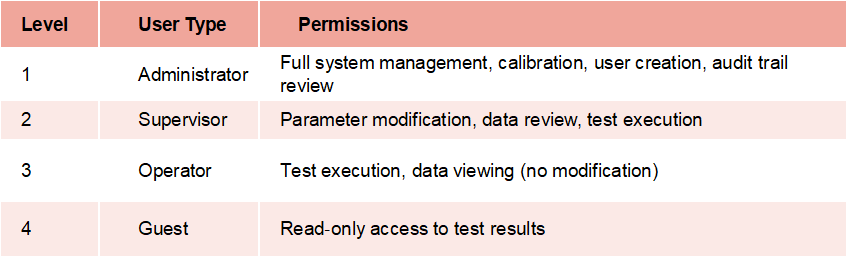
This structure ensures that operators cannot modify test parameters or delete records, while administrators retain full oversight – a key requirement for GMP compliance and FDA inspections.
Secure Audit Trail – Every Action is Recorded
Sumspring instruments automatically generate a computer‑generated, time‑stamped audit trail that records all user and system activities, including:
- User login/logout
- Test parameter changes
- Test execution and completion
- Data export and printing
- System events and alarms
All audit trail data is stored in an encrypted, tamper‑evident format, and no user – including administrators – can disable or modify the audit trail. This ensures that regulatory inspectors can confidently reconstruct the complete history of every test.
Accurate Time Stamps – Ensuring Event Chronology
Time stamps are critical for establishing the sequence of events and verifying that activities were performed in the correct order and within specified timeframes.
Sumspring instruments use a system‑level, secure time source that cannot be modified by operators. All records are automatically time‑stamped with date and time, ensuring:
- Tests are performed within the required time windows
- Audit trail events reflect the true sequence of activities
- Regulatory inspectors can verify compliance with SOPs
This capability supports global regulatory expectations and ensures that every recorded event reflects the actual sequence of manufacturing or testing activities.
Data Storage and Export – Preserving Records for the Long Term
All test data is stored in a password‑protected, encrypted database that prevents unauthorized access or modification. GMP‑related records are retained in compliance with regulatory requirements and cannot be deleted or altered to conceal results.
Sumspring instruments also offer:
- Secure data export – raw data can be exported as unalterable database files or PDF/A‑2 format for long‑term archiving
- Backup and recovery – ensuring data protection against system failure or disaster
- LIMS/ERP integration – via RS232, USB, or Ethernet interfaces for centralized data management
Industry-Specific Applications: Why Data Integrity Matters in Packaging Testing
In pharmaceutical packaging testing, data integrity is particularly critical because:
Seal Integrity Testing (CCIT): Vacuum decay and high voltage leak detection results must be fully traceable to demonstrate that sterile products remain protected throughout their shelf life. Without a secure audit trail, manufacturers cannot prove that packaging integrity was properly verified.
Syringe Testing: Plunger sliding force, seal integrity, and leakage tests require precise, documented records to support product release decisions.
Torque Testing: Bottle cap opening and tightening torque values must be accurately recorded to ensure patient safety and product quality.
Regulatory Audits: During FDA, NMPA, or EMA inspections, auditors will request complete, unalterable records of packaging testing results. Instruments that lack robust data integrity features can lead to observations or even warning letters.
Sumspring instruments are specifically designed to address these requirements, providing the data integrity controls that pharmaceutical manufacturers need for compliance.