How to Completely Resolve Sterile Syringe Leakage? A Technical Solution for Positive Pressure Tightness Testing (ISO 7886-1 & USP <1381>)
I. Industry Pain Points: Why Do Syringes Fail Under Clinical Pressure?
The sealing mechanism of a syringe fundamentally relies on the dynamic interference fit between the rubber plunger's ribs and the plastic/glass barrel. When leakage occurs, it is typically driven by the following technical defects:
- Dimensional Tolerances: Uneven internal barrel diameters or slight tapering can cause inconsistent contact stress as the plunger advances.
- Inconsistent Siliconization: Uneven silicone oil distribution leads to abrupt changes in friction, causing the plunger ribs to deform or flip under pressure.
- Extreme Clinical Loads: When injecting high-viscosity formulations (e.g., hyaluronic acid, certain monoclonal antibodies) or using high-pressure contrast media injectors, the instantaneous backpressure generated within the fluid path often exceeds the plunger's critical sealing threshold.
Traditional qualitative testing methods—such as manual water injection followed by visual inspection—fail to simulate real-world, sustained high-pressure conditions and lack the quantitative data required for true process optimization. Therefore, implementing standardized positive pressure tightness testing is the prerequisite for resolving leakage issues.
II. Compliance Benchmarks: Aligning with Global Regulatory Standards
To effectively mitigate leakage risks and ensure smooth international market access, medical device manufacturers must align their testing protocols with two core regulatory frameworks:
- ISO 7886-1:2019 (Strict Quantitative Metrics) As the globally recognized standard for single-use sterile syringes, ISO 7886-1 mandates a dynamic-to-static positive pressure test. A pressure of not less than 300 kPa (approx. 3 bar) must be applied to the internal fluid and maintained for at least 30 seconds. Under these sustained high-pressure conditions, absolutely no liquid must leak from the plunger or the barrel connections.
- USP <1381> (Risk-Based Design Verification) The US Pharmacopeia (USP) <1381> emphasizes risk management throughout the product lifecycle. Rather than dictating a single static value, it requires that the syringe must withstand the maximum pressure likely to be encountered in the most severe clinical environments. In practical applications and FDA submissions, manufacturers often conduct destructive or limit testing between 300 kPa and 500 kPa to establish a robust safety margin.
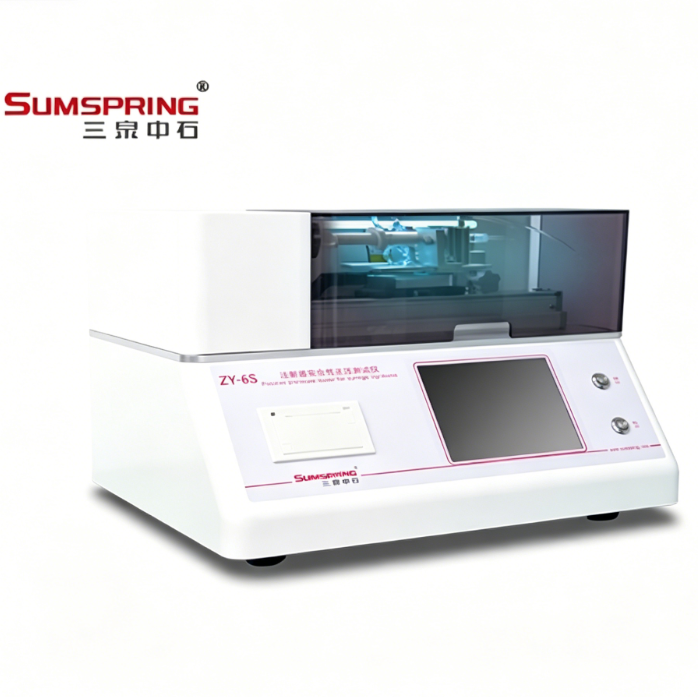
III. The Core Technical Solution: Sumspring ZY-6S Syringe Tightness Tester
To thoroughly detect and resolve leakage, QA/QC labs require testing equipment capable of delivering absolutely stable high pressure, high-precision feedback, and tamper-proof data. The Sumspring ZY-6S Syringe Positive Pressure Tester is engineered specifically to overcome these technical bottlenecks:
1. Closed-Loop Servo High-Pressure Drive (Eliminating Pressure Decay)
Conventional pneumatic or open-loop testers often suffer from pressure decay once the target pressure is reached, leading to false-pass results. The ZY-6S utilizes a precision servo-driven mechanism paired with a highly sensitive Class 0.5 pressure sensor to form a real-time closed-loop feedback system. It allows stepless pressure adjustments from 0 to 400 kPa (expandable to 500 kPa) and rigidly controls pressure fluctuations within ±5% during the 30-second hold time, perfectly replicating the severe environments mandated by ISO standards.
2. Dynamic Adaptation for Multiple Specifications (Pinpointing Leakage Nodes)
Syringes of different volumes (1mL to 60mL) exhibit distinct fluid dynamic behaviors during injection. The ZY-6S features stepless speed control ranging from 0.1 to 100 mm/min. This allows R&D engineers to precisely simulate the injection of drugs with varying viscosities, accurately capturing the exact displacement node and pressure point where plunger leakage occurs, thereby providing actionable data for mold correction.
3. Uncompromising Data Integrity (GMP & ALCOA+ Compliance)
To meet the stringent audit requirements of multinational pharmaceutical companies, the ZY-6S is equipped with a robust data management system:
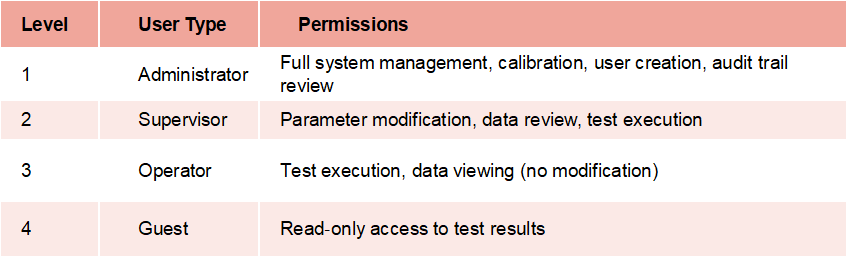
- Three-Tier Access Control: Segregates permissions among Operators, Reviewers, and Administrators to prevent unauthorized adjustments.
- Comprehensive Audit Trails: Automatically and securely records all test parameters, timestamps, results, and alarms, ensuring data is strictly non-editable.
- Automated Reporting: Supports real-time printing via a built-in micro-printer (including timestamps, device IDs, and operator signatures) and can seamlessly integrate with enterprise LIMS systems, ensuring absolute compliance for batch release.