Food Flexible Packaging Seal Integrity Testing Solution: A Case Study of Biscuit and Potato Chip Bags
For baked and puffed foods like biscuits and potato chips, the seal integrity of the packaging plays a crucial protective role throughout the entire cycle from the production line to final consumption. Seal failure can lead to the ingress of oxygen, moisture, or contaminants, which not only causes product spoilage but also severely damages brand reputation. Implementing standardized seal integrity testing is an indispensable part of food packaging quality control.
Core Testing Standard: ASTM D3078 Bubble Leak Method
For flexible packaging containing headspace gas (such as nitrogen-flushed potato chip bags or biscuit bags with a certain gas volume), ASTM D3078 provides a highly standardized and practical vacuum bubble testing method. This method immerses the test specimen in water and applies a vacuum pressure differential, indicating leaks by observing whether the packaging releases a continuous stream of bubbles.
- Visually Locating Defects: A continuous stream of escaping bubbles helps operators quickly pinpoint the exact locations of incomplete heat seals, material damage, or micro-leaks.
- Broad Applicability: Perfectly adapts to various shapes and sizes of flexible packaging formats.
- Data Consistency: Adhering to international standards significantly enhances the comparability and credibility of test results across different production lines and shifts.
Potential Risks of Packaging Seal Failure
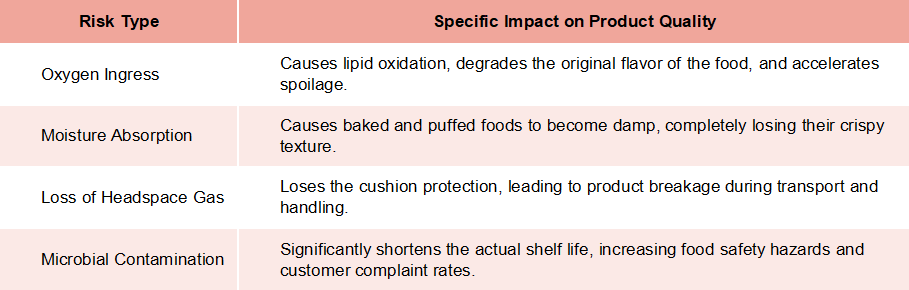
If an effective closed system cannot be maintained during distribution, food packaging faces multiple quality risks:
Recommended Testing Solution: Sumspring MFY-05S Leak Tester
To establish an efficient and reliable quality monitoring system, we recommend using the Sumspring MFY-05S Leak Tester for routine seal integrity testing. Designed specifically for food flexible packaging, this equipment perfectly aligns with the ASTM D3078 standard and can efficiently detect both major and minor leaks in packaging.
Core Advantages of the Equipment
- Precise Vacuum Control: Provides a stable and highly adjustable negative pressure environment, avoiding abnormal packaging rupture or distorted results due to excessive vacuum.
- High-Transparency Observation: Features a thickened transparent vacuum chamber design, ensuring quality control personnel can clearly and comprehensively capture even the slightest bubble escapes.
- High Repeatability and Ease of Use: Equipped with automatic pressure maintenance, intelligent timing, and one-key pressure release functions. This ensures absolute consistency in every test condition, making it highly suitable for high-frequency routine spot checks on the production floor.
Key Variables Affecting Testing Accuracy
When conducting bubble leak testing, the inherent properties of the packaging and environment can affect test performance. Accurately understanding these variables helps avoid misjudgments:
- Headspace Volume and Expansion Behavior: The initial volume of gas within the packaging determines its degree of expansion in a vacuum environment.
- Material Physical Properties: The thickness and flexibility of the packaging material will affect its response to internal and external pressure differentials.
- Vacuum Level and Pressure Change Rate: Inappropriate vacuum parameters may mask minor leaks or conversely cause weak heat seals to rupture.
Quality Control Best Practices
To maximize the effectiveness of the Sumspring MFY-05S Leak Tester, manufacturing enterprises should implement the following standard operating procedures in routine quality inspections:
- Set Custom Parameters: Establish appropriate vacuum limits and hold times for potato chip and biscuit bags of different weights and materials.
- Standardize Operator Judgment: Train operators to accurately distinguish between static air bubbles trapped on the packaging surface and continuous bubble streams that represent actual leaks.
- Scientific Sampling Mechanism: Ensure representative samples from every production line and batch are tested to create comprehensive quality traceability data.
- Regular Equipment Validation: Periodically calibrate the testing equipment for air-tightness and vacuum accuracy to ensure long-term operational precision.